How to Choose a Sea Moss Supplement: A Buyer's Checklist
Five things that matter — species, third-party testing, stated iodine, GMP manufacturing, and honest claims — and six marketing signals that mean less than they appear to.
In this story
Evidence-led guidance for making a more informed wellness decision.
← All journal storiesShort answer. Judge a sea moss supplement on five things: a named species and harvest origin, a current third-party certificate of analysis covering heavy metals, a stated iodine amount per serving, manufacturing in a GMP-certified facility, and a label that does not make disease claims. Price and mineral-count marketing are the two worst signals to buy on.
Why this category needs more scrutiny than most
Sea moss is a wild-harvested marine organism. Seaweed absorbs minerals from the water around it and does not distinguish between the ones you want and the ones you do not — arsenic, lead, cadmium and mercury included. Iodine content also swings widely by species, harvest site and season.
That means two jars of sea moss with identical labels can genuinely differ in both what they deliver and what they carry. In most supplement categories, testing is a nice-to-have. Here it is the product.
The five things that matter
1. A named species and origin
The label should tell you what you are eating and where it came from. Chondrus crispus is true Irish moss from cold North Atlantic waters; Gracilaria species are typically farmed in warmer Caribbean and Southeast Asian waters. Both are legitimate. What is not legitimate is a label that just says “sea moss” with no species and no origin — that is a supply chain the brand either does not know or does not want to describe.
“Wildcrafted” means harvested from a natural population rather than farmed. It is a reasonable thing to want, but on its own it says nothing about water quality. Wildcrafted plus a clean-water origin plus testing is the actual claim worth paying for.
2. A current third-party certificate of analysis
This is the non-negotiable one. A COA is a lab report from an independent testing facility — not the manufacturer — showing what a specific batch actually contains. For sea moss it should cover heavy metals at minimum, and ideally microbial contamination and iodine.
Two details separate a real COA from decoration:
- It should be current and batch-specific. A report from three years ago tells you about seaweed you are not buying.
- It should be available on request. A brand that will send you one has nothing to hide. A brand that deflects has answered your question.
3. A stated iodine amount
Adult iodine intake is 150 mcg per day, with a tolerable upper limit of 1,100 mcg from all sources. A sea moss product that does not tell you its iodine content per serving is asking you to dose blind on the one nutrient where the margin is narrow.
This is also how you check whether you can safely combine products, or whether your multivitamin already covers it. More detail in Sea Moss Side Effects and Who Should Avoid It.
4. GMP-certified manufacturing
Good Manufacturing Practice certification means the facility is audited for consistency, cleanliness and accurate labelling. It does not certify the raw material — that is what the COA is for — but it means the finished product reliably matches the label. In the US, look for a GMP-certified facility and, ideally, NSF or USP involvement.
5. A label that does not overclaim
Dietary supplements may make structure/function claims (“supports normal immune function”) but not disease claims (“treats arthritis”, “cures thyroid disease”). A brand willing to cross that line on the label is telling you how it treats the rules it thinks you will not check — including testing.
Every legitimate supplement label carries the FDA disclaimer. Its absence is a red flag.
Signals that mean less than they appear to
| Claim | What it is actually worth |
|---|---|
| “92 of 102 minerals” | Category folklore, not an assay result. Read it as “broad trace-mineral profile”. See What Is Sea Moss? |
| “Raw” / “straight from the ocean” | Fine for sea moss gel. A warning sign for shilajit, where purification is a safety step |
| “Doctor formulated” | Unregulated phrase. No specific qualification is implied |
| “Clinically proven” | Ask which study, on which product, in how many people. Usually it refers to one ingredient, not the formula |
| Proprietary blend | Legal, but it hides how much of each ingredient you get. Fine for flavour components, less so for actives |
| Lowest price per jar | The cheapest input in this category is untested wild seaweed. Price is a downstream signal of sourcing |
Choosing a format
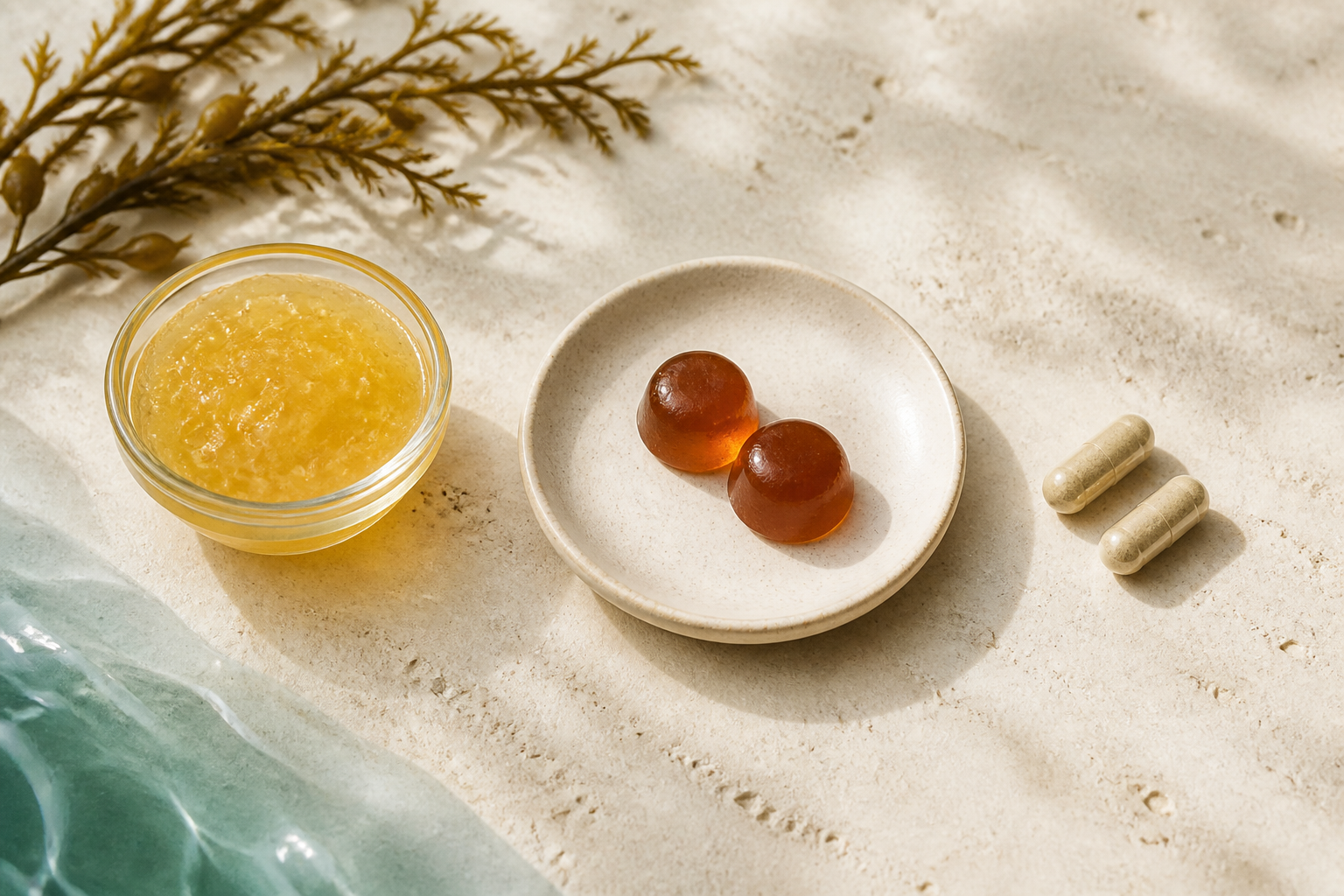
Once a product clears the five checks above, format is a personal question rather than a quality one. Gel is rawest and most versatile but needs refrigeration; gummies are the easiest to take daily; capsules are the most portable and tasteless. We compared them properly in Sea Moss Gummies vs Gel vs Capsules.
The honest framing: the best format is whichever one you will still be taking in week six, because nothing in this category works on a two-week trial.
A quick checklist
- Species named on the label?
- Harvest origin stated?
- Current third-party COA available on request?
- Heavy metals tested?
- Iodine per serving disclosed?
- GMP-certified facility?
- Structure/function claims only, with the FDA disclaimer present?
- Serving size and full ingredient list — no unexplained proprietary blend?
- A format you will actually take every day?
Happy Fin Labs products use wildcrafted sea moss, are third-party tested for purity, heavy metals and contaminants, and are manufactured in GMP-certified US facilities. If you want to see a certificate of analysis for the batch you received, email support@happyfinlabs.com and we will send it.
Frequently asked questions
What should I look for in a sea moss supplement?
A named species and origin, a current third-party certificate of analysis covering heavy metals, a stated iodine amount per serving, GMP-certified manufacturing, and a label free of disease claims. Those five things separate a tested product from repackaged wild seaweed.
Is more expensive sea moss better?
Not automatically, but the reverse is more reliably true: the cheapest products in this category are cheap because they skip testing and sourcing controls. Price is a weak positive signal and a strong negative one.
What is a certificate of analysis?
An independent laboratory report on a specific production batch, showing measured contaminant levels and often nutrient content. It is the only direct evidence that what you are taking is clean. Ask for one that is current and batch-specific.
Is wildcrafted sea moss better than farmed?
Not inherently. Wildcrafted moss grows in a natural environment; farmed moss grows in controlled conditions, which can mean more consistency. Water quality determines contamination in both cases, which is why testing matters more than the label word.
How do I know if sea moss is fake?
Real dried sea moss is irregular in shape and colour, salty, and swells to several times its size when soaked. Uniformly coloured or oddly regular product is a warning sign. But visual checks cannot detect heavy metals — only a lab report can, which is why the COA is the real test.
Should I buy sea moss with added ingredients?
It depends on whether they earn their place. Blended products are convenient and can be well formulated, but every added ingredient is one more thing to check for interactions and duplication with what you already take. Read the full ingredient list, not just the front of the jar.
These statements have not been evaluated by the Food and Drug Administration. This product is not intended to diagnose, treat, cure, or prevent any disease. Consult your healthcare provider before starting any supplement, particularly if you are pregnant, nursing, taking medication, or managing a thyroid condition.
Our journal is designed to make supplement science easier to understand. It is educational and does not replace personalized medical advice.