What Is Sea Moss? Benefits, Minerals & How to Take It
Sea moss is an edible red seaweed eaten for its trace minerals. What it is, what it actually contains, how much to take, and who should be careful.
In this story
Evidence-led guidance for making a more informed wellness decision.
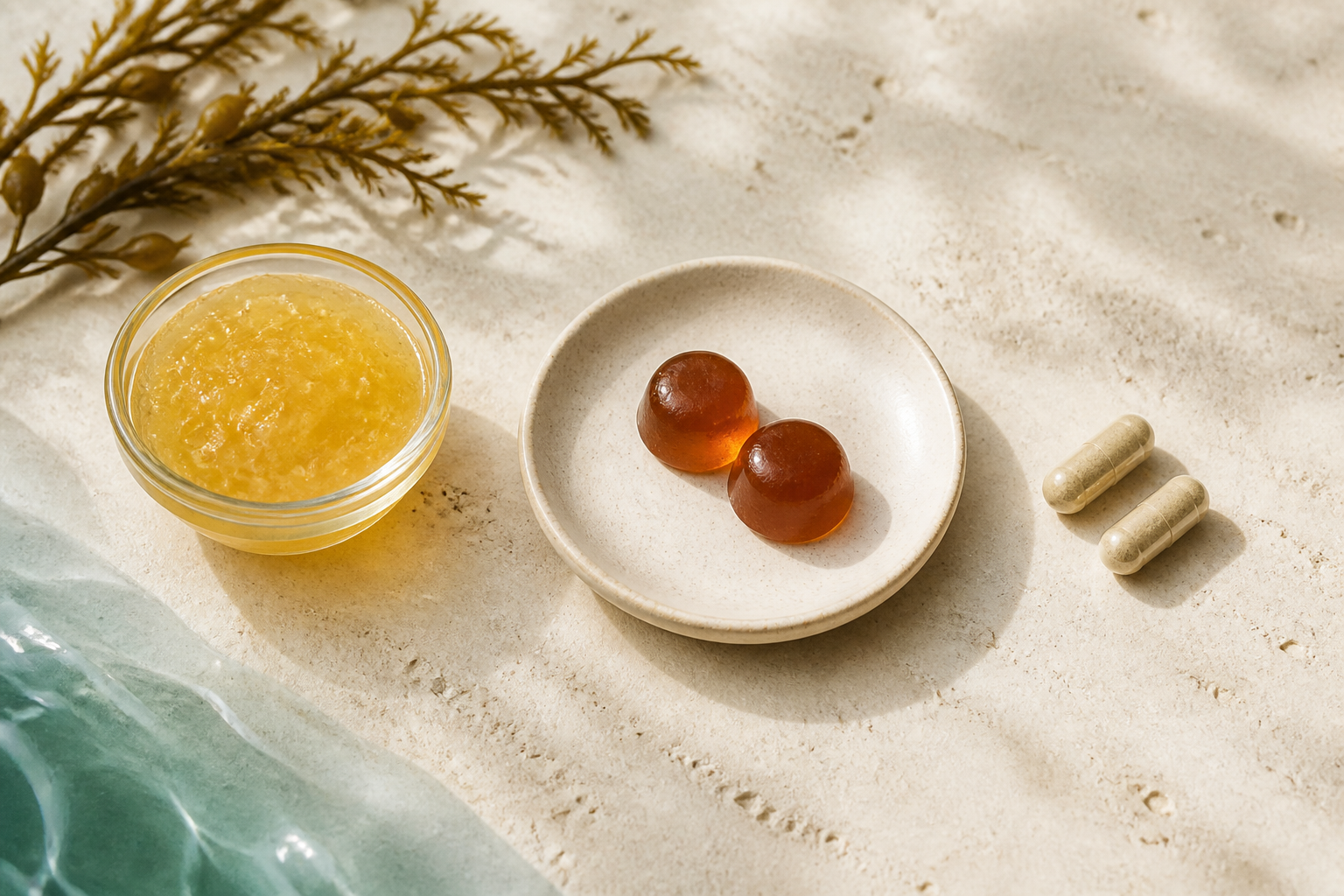
← All journal storiesShort answer. Sea moss is an edible red seaweed — most often Chondrus crispus (Irish moss) or Gracilaria — harvested from cool coastal waters. It is eaten as a gel, gummy, powder or capsule for its mineral content, particularly iodine, potassium, magnesium, calcium and selenium. A typical daily serving is 1–2 tablespoons of gel or 2 gummies.
What is sea moss, exactly?
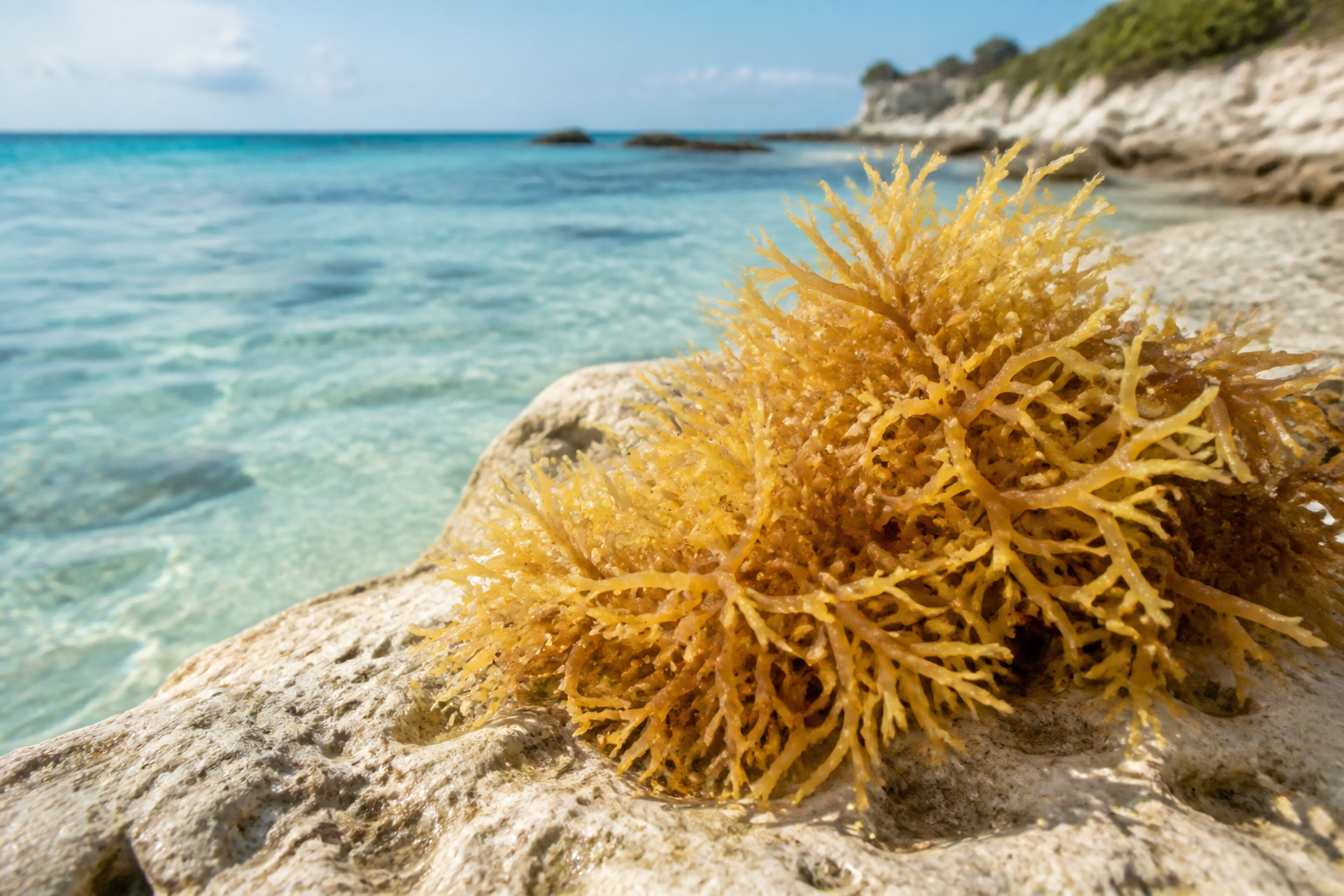
Sea moss is not a moss. It is a marine red alga that grows on rocks along cold Atlantic coastlines — Ireland, Scotland, Maine, and the Canadian Maritimes — and in warmer Caribbean waters. Two species account for almost everything sold as “sea moss”:
- Chondrus crispus — true Irish moss. Flat, fan-shaped, deep purple-red fronds. This is the traditional North Atlantic species.
- Gracilaria spp. — thin, stringy, gold or purple. Commonly farmed in the Caribbean and Southeast Asia and often labelled “gold sea moss” or “purple sea moss”.
Both have been eaten for centuries. Irish moss was a famine food and a folk remedy for chest complaints in 19th-century Ireland, and it is still the traditional base of Jamaican “Irish moss” drinks. Industrially, Chondrus crispus is also the original source of carrageenan, the gelling agent in ice cream and plant milks.
Happy Fin Labs uses wildcrafted Chondrus crispus across our Sea Moss Gummies and Liposomal Sea Moss Gel.
What nutrients does sea moss actually contain?
Sea moss is a genuinely mineral-dense food, because seaweed concentrates minerals dissolved in seawater. The nutrients present in meaningful amounts are well documented:
| Nutrient | Why it matters |
|---|---|
| Iodine | Required for normal thyroid hormone production. Sea moss is one of the richest dietary sources — which is also why dose matters. |
| Potassium | Supports normal muscle function and fluid balance. |
| Magnesium | Involved in hundreds of enzyme reactions, including energy metabolism. |
| Calcium | Contributes to normal bone maintenance. |
| Iron | Supports normal oxygen transport and reduction of tiredness. |
| Zinc & selenium | Contribute to normal immune function and protection from oxidative stress. |
| Soluble fibre (carrageenan-type polysaccharides) | Gives sea moss gel its texture; acts as a prebiotic fibre in the gut. |
About the “92 of 102 minerals” claim
You will see this figure everywhere in the sea moss category. It is worth being straight about: it originates in popular wellness literature, not in a published assay of a specific batch. Read it as shorthand for “a broad trace-mineral profile” rather than a lab-verified count. The minerals in the table above are the ones that are consistently measurable and that actually do something. Any brand that can show you a current third-party certificate of analysis is telling you more than a headline number can.
What is sea moss used for?
People take sea moss for four broad reasons. These are nutritional support claims, not medical ones — sea moss is a food, and it works by filling gaps rather than by treating conditions.
- Mineral intake. The most defensible reason. If your diet is light on seafood and leafy greens, trace minerals are a real gap.
- Thyroid and energy support. Iodine is a required substrate for thyroid hormone, and thyroid hormone sets your metabolic rate. Adequate iodine supports normal energy metabolism; extra iodine beyond adequacy does not.
- Digestive comfort. The gel-forming polysaccharides act as soluble fibre and feed gut bacteria.
- Skin and hair. Largely down to zinc, sulphur compounds and hydration. Sea moss gel is also used topically as a mask.
How much sea moss should you take per day?
There is no official RDA for sea moss itself, so the sensible limit is set by its iodine content. For adults, the recommended iodine intake is 150 mcg per day and the tolerable upper limit is 1,100 mcg per day from all sources. Iodine in seaweed varies enormously between species and harvests, which is the single strongest argument for buying from a brand that tests each batch.
Practical starting points:
- Gel: 1–2 tablespoons daily.
- Gummies: 2 gummies daily.
- Raw dried moss: soak, blend and treat the resulting gel as above.
Start at the low end for the first week. More is not better with iodine — both too little and too much disturb normal thyroid function.
Gel, gummies, or capsules?
All three deliver the same seaweed. They differ in taste, convenience and dose control. We broke the trade-offs down in Sea Moss Gummies vs Gel vs Capsules, but the short version: gel is the most traditional and the most versatile, gummies are the most likely to actually get taken every day, and capsules are the most neutral-tasting.
Who should be careful with sea moss?
Sea moss is well tolerated by most people, but it is not for everyone. Talk to your doctor first if you have a thyroid condition, are pregnant or breastfeeding, take thyroid or blood-thinning medication, or have a shellfish or iodine allergy. Full detail in Sea Moss Side Effects and Who Should Avoid It.
Frequently asked questions
Is sea moss a superfood?
“Superfood” is a marketing word with no regulatory definition. Sea moss is a nutrient-dense whole food with an unusually high mineral content for its calorie load. That is a fair description; anything stronger is salesmanship.
Does sea moss have to be refrigerated?
Gel does — it is a raw, water-based food and keeps for about 3–4 weeks refrigerated. Gummies, capsules and dried moss are shelf-stable at room temperature.
What does sea moss taste like?
Raw sea moss gel tastes faintly of the ocean — briny and mildly earthy — with a slippery texture. It disappears into smoothies, coffee or soup. Flavoured gummies were designed specifically to get around this.
Can you take sea moss every day?
Yes, at a sensible serving size. Daily consistency is how mineral intake actually shifts. What matters is staying within a reasonable iodine range rather than doubling up.
Is sea moss vegan?
Sea moss itself is a seaweed, so yes. Check the delivery format though — some gummies use gelatin. Happy Fin Labs gummies use pectin and are vegan.
How long does sea moss take to work?
Most people are looking at 2–6 weeks of daily use before they notice anything, depending on what they are tracking. See How Long Does Sea Moss Take to Work?
These statements have not been evaluated by the Food and Drug Administration. This product is not intended to diagnose, treat, cure, or prevent any disease. Consult your healthcare provider before starting any supplement, particularly if you are pregnant, nursing, taking medication, or managing a thyroid condition.
Our journal is designed to make supplement science easier to understand. It is educational and does not replace personalized medical advice.