Can You Take Sea Moss and Shilajit Together?
Yes — no known interaction, and they do different jobs. How to introduce them, what dose to use, what to watch for, and who should skip the combination.

In this story
Evidence-led guidance for making a more informed wellness decision.
← All journal storiesShort answer. Yes — sea moss and shilajit are commonly taken together and there is no known interaction between them. They do different jobs: sea moss supplies trace minerals and iodine, shilajit supplies fulvic acid and dibenzo-α-pyrones associated with energy metabolism. Take both with breakfast at their normal individual doses. Introduce them one at a time, two weeks apart, so you can tell which is doing what.
Why they pair well
Stacking supplements usually makes sense when the two things solve different problems. That is the case here.
| Sea moss | Shilajit | |
|---|---|---|
| What it supplies | Iodine, potassium, magnesium, calcium, iron, zinc, selenium, soluble fibre | Fulvic acid, humic substances, dibenzo-α-pyrones, trace minerals |
| What it is for | Filling mineral gaps in the diet | Energy metabolism, stamina, focus |
| How it feels | Quiet — a raised baseline over weeks | Also quiet, but more associated with stamina and recovery |
| Timeline | 2–6 weeks | 8–12 weeks |
There is also a plausible mechanistic reason they complement each other, though it should be held loosely. Fulvic acid is a natural chelator — it binds mineral ions and is thought to assist their transport. Sea moss is a mineral source. The idea that one improves uptake of the other is chemically reasonable and frequently repeated, but it has not been demonstrated in a controlled human trial of the two together. Treat it as a sensible hypothesis, not a proven multiplier.
How to take them together
- Start with one. Take sea moss alone for two weeks. Adding two new things at once means that if something changes — good or bad — you will not know which caused it.
- Add shilajit at week three. Same principle in reverse.
- Both with breakfast. Food improves uptake of fat-soluble nutrients, and a single anchored moment is what makes a two-product routine survive past week two.
- Normal doses, not reduced ones. Taking them together does not mean halving either. Standard servings: 2 sea moss gummies or 1–2 tbsp gel, and 250–500 mg purified shilajit.
- Give it 90 days. Shilajit is the slower of the two and sets the pace for judging the stack.
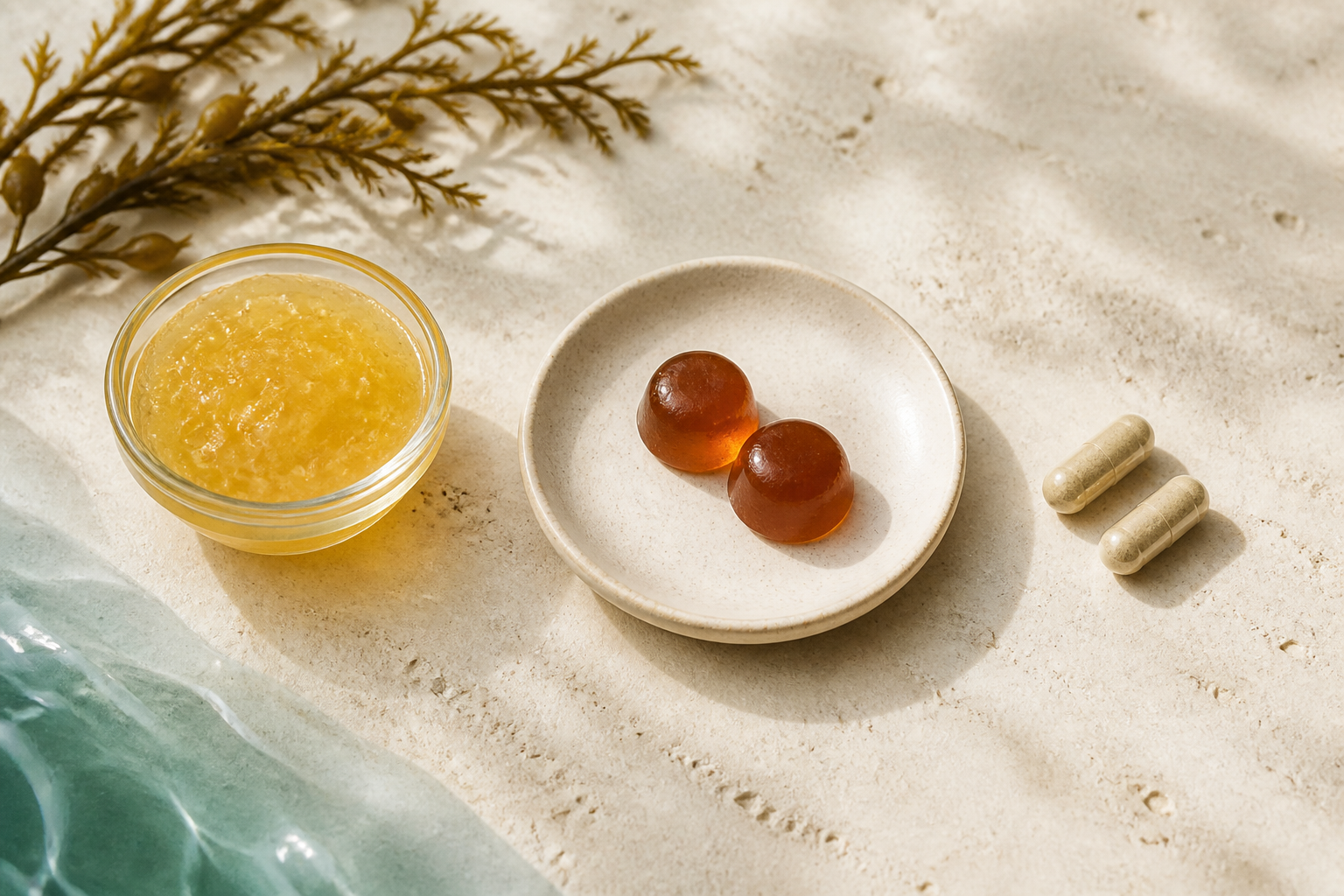
The simplest version of this routine is two gummies of each — our 16-in-1 Sea Moss Gummies and Pineapple Shilajit Gummies — taken at the same time each morning.
What to watch out for
The interaction risk between these two is low. The risks worth tracking are the ones each carries on its own, and they do not cancel out when combined.
- Total iodine. Sea moss is the iodine source here, and adult intake is 150 mcg a day against an upper limit of 1,100 mcg. Adding shilajit does not change that arithmetic, but adding a second sea moss product would. One sea moss product at a time.
- Iron. Both contain iron. It is a small amount from either, but anyone with haemochromatosis or iron overload should avoid shilajit entirely.
- Heavy metals. Both categories have genuine sourcing risk — seaweed concentrates what is in the water, and unpurified shilajit can carry contaminants from rock. Stacking two untested products doubles your exposure. Third-party certificates of analysis matter more, not less, when you combine.
- Medication. Thyroid medication and blood thinners interact with sea moss; blood pressure, diabetes and hormone-related medication warrant a check before shilajit. Bring both labels to your pharmacist.
Who should not combine them
Skip the stack, or speak to your doctor first, if you are pregnant or breastfeeding, have any thyroid condition, have haemochromatosis or another iron storage disorder, have kidney disease, or take thyroid, blood-thinning, blood pressure or diabetes medication. Children should not take either.
Is there a best time of day?
Morning, with food, for both — but the reasoning is practical rather than pharmacological. Neither is a stimulant and neither has a demonstrated circadian advantage. Morning simply gives you one anchor point instead of two, and the failure mode for supplement stacks is almost always forgetting rather than mistiming.
If you find morning doses hard to remember, pick whichever meal you never skip and attach both to that.
Frequently asked questions
Can you take sea moss and shilajit at the same time?
Yes. There is no known interaction between them, and taking both with the same meal is the most practical approach. They target different things — minerals versus energy metabolism — so combining is complementary rather than redundant.
Does shilajit improve sea moss absorption?
Possibly, but it is unproven. Fulvic acid in shilajit binds and transports mineral ions, which makes the idea chemically plausible, and it is repeated often in the category. No controlled human trial has tested the combination. Take it as a reasonable bonus rather than the reason to stack.
Should I take them at different times of day?
There is no need. Separating them offers no known advantage and makes the routine harder to keep. The exception is if you find that taking everything at once upsets your stomach — in which case split them between breakfast and lunch.
How long before I notice anything from the combination?
Judge it at 90 days. Sea moss effects tend to appear at 2–6 weeks and shilajit at 8–12, so the slower of the two sets the review date.
Is it safe to take sea moss and shilajit every day?
For healthy adults using purified, third-party-tested products at labelled doses, daily use is the intended pattern for both. Neither needs cycling. The caveats are the individual ones — thyroid conditions, iron disorders, pregnancy, medication.
Can I add other supplements to this stack?
Usually, but add them one at a time and watch for overlap rather than count. The common mistake is duplicating an ingredient across products — a multivitamin with iodine on top of sea moss, or a greens powder that also contains kelp. Read the labels for repeats, not just for what is new.
These statements have not been evaluated by the Food and Drug Administration. This product is not intended to diagnose, treat, cure, or prevent any disease. Consult your healthcare provider before combining supplements, particularly if you are pregnant, nursing, taking medication, or managing a thyroid or iron storage condition.
Our journal is designed to make supplement science easier to understand. It is educational and does not replace personalized medical advice.